











Russian Federation
Russian Federation
UDC 639.21
The Curonian Lagoon is located in the southwestern part of the Baltic Sea and is geographically under the administrative control of the Russian Federation and the Republic of Lithuania. The water body is connected to the Baltic Sea by a narrow strait in the northern part located in the Republic of Lithuania. About 50 species of fish live in the lagoon, of which 25 species are of commercial importance. The European smelt Osmerus eperlanus is a migratory species; it spawns in the rivers of the Curonian Lagoon, the main spawning grounds are in the Neman, Deima, and Matrosovka rivers. Most of their life smelts live in the Baltic Sea where they fatten up. The spawning part of the smelt population is caught in the Curonian Lagoon. In commercial catches, smelt are represented by individuals from 1 to 6 years old, for the most part, individuals mature at the age of 2 to 3 years. The research used reproductive figures for smelt from 1989 to 2001. The weight of females varied from 8.3 to 113.4 g, averaging 47.2 g. The absolute individual fertility of smelts varied from 3,300 to 93,100 eggs averaging 32,000 eggs. The relative individual fertility averaged 900 eggs/g. The gonadosomatic index (reproductive effort) averaged 0.27, the egg diameter varied from 0.59 to 0.98 mm averaging 0.77 mm. It can be concluded that the reproductive performance of the European smelt O. eperlanus exceeded the reproductive performance of smelts in other water bodies of the northwest of the Russian Federation. The smelt fertility study in the Curonian Lagoon showed that the reproductive capacity of the species is in good condition, which is apparently due to good trophic conditions in the feeding area, the Baltic Sea.
Osmerus eperlanus, Curonian Lagoon, fertility, reproductive effort
Introduction
The Curonian Lagoon is located in the southeast part of the Baltic Sea and is a transboundary water body, as it is administratively subordinate to the Russian Federation and the Republic of Lithuania. The lagoon is a closed lagoon-type estuary and has the shape of a right triangle with a strait connecting it with the Baltic Sea at the apex. According to the hydrological, hydrochemical and hydrobiological regimes, the water body can be classified as a closed lagoon-type estuary. According to the trophic status, the water body belongs to eutrophic waters, which in certain periods turn into a hypertrophic status [1].
More than 50 fish species are caught in the lagoon, both non-migratory and migratory. Smelt belongs to the anadromous species spawning in the rivers of the Curonian Lagoon and fattening in the Baltic Sea. In the Curonian Lagoon, the European smelt Osmerus eperlanus (Linnaeus, 1758) forms two intraspecific forms; anadromous smelt, which spawns in rivers and goes to the sea to fatten, and European smelt (O. eperlanus m. spirinchus Pallas), which does not go to sea and spawns in the estuaries of the rivers flowing into the Curonian Lagoon. Smelt is caught in the spring, during the spawning migration. The main rivers, in which smelt spawn, are the Neman, Deima and Matrosovka.
The population of European smelt in the Curonian Lagoon in commercial catches is represented by 1-6-year-old individuals from 9 to 25 cm in length and an average weight of 10 to 108 g. This is a short-cycle species, which generally matures by the age of 3. The basis of the spawning commercial stock is made up of 3-4-year-olds. The catch of smelt in the lagoon varies significantly from year to year. The short life cycle determines the high interannual rate of the resources and, accordingly, the size of the commercial catch (in 1958-2001 it varied from 7 to 1 173 tons).
Fertility is one of the most important parameters of a species, which makes it possible for you to assess its reproductive capabilities. At the same time, fertility and the associated indicators are used as an indirect parameter by which one can assess the habitat conditions of the species and the dynamics of the population [2-5]. In this regard, itis necessary to study fertility when studying the fish population dynamics and assessing the commercial stock and catch.
The purpose of the work is to determine the reproductive indicators of the smelt of the Curonian Lagoon.
Material and methods
The material was collected at the Dobrovolets collective fishery in the southern part of the Curonian Lagoon, which is a traditional place for collecting material on spring-spawning fish species. Samples for biological analysis were taken from commercial fishing gear according to the generally accepted method [6]. The commercial and zoological length of individuals, gutted and not gutted, gonad weight, and egg diameter were measured, and the age of the fish was determined. Gonads were collected from individuals at maturity stage IV. The commercial stock was calculated based on biostatistical data [7].
The reproductive parameters of smelt were studied from 1989 to 2001. In total, more than 600 gonads were processed. The reproductive parameters used were absolute individual fertility (AIF) – the total amount of eggs in the gonad, relative individual fertility (RIF) – the ratio of AIF to the gutted female’s weight, and the diameter of the eggs. Reproductive effort (Wgen) was calculated as the ratio of the gonad weight to the gutted fish’s body weight.
Statistical processing of the material was carried out in the Statistica programme, version 6.
Research results
The spawning part of the smelt population was represented by individuals from 1 to 6 years old. Individuals of 3 to 4 years old prevailed in number; only in some years, when a high-yielding generation appeared, reproductive females of 1-year-old were recorded (1992 and 2001). The average weight of reproductive females in commercial catches varied from 8.3 to 113.4 g. In the long-term average aspect, it was 47.2 g.
The absolute individual fertility of smelt varied within a wide range: from 3,300 eggs for yearlings to 99,200 eggs for 5-yearlings. The main reproductive parameters of the spawning population of smelt are given in Table.
Reproductive characteristics of the spawning part of the smelt population of the Curonian Lagoon
|
Parameter |
Minimum |
Maximum |
Average |
|
Absolute individual fertility, thousand eggs |
3.3 |
93.1 |
32.0 |
|
Relative individual fertility, thousand eggs |
0.4 |
2.1 |
0.9 |
|
Gonad weight, g |
1.1 |
26.4 |
8.0 |
|
Egg diameter, mm |
0.59 |
0.98 |
0.77 |
|
Female weight, g |
8.3 |
113.4 |
47.2 |
|
Gonadosomatic index |
0.16 |
0.33 |
0.27 |
Absolute individual fertility and body weight of females with a high determination factor were described by an allometric equation (Fig. 1).

Fig. 1. Dependence of absolute individual fertility (AIF) on the body weight of females.
Absolute and relative individual fertility depended on the age of females. Absolute individual fertility increased regularly with the age of the females: on average from 3 300 pieces for yearlings to 65 500 pieces for six yearlings and was described by a power function (R2 = 0.99) (Fig. 2).
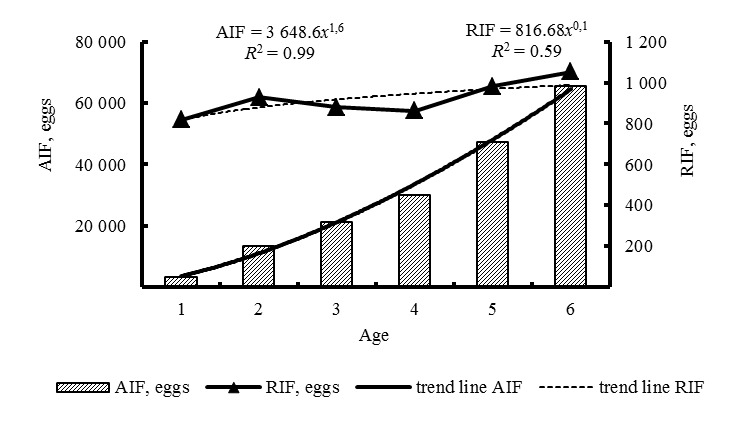
Fig. 2. Dependence of absolute (AIF) and relative (RIF) individual fertility of smelt on the age (year) of females.
Relative individual fertility varied within narrow limits: minimum for yearlings (820 eggs/g) and maximum for six yearlings (1 050 eggs/g). For three to four yearlings, it remained at the level of 870 eggs/g. This dependence also had a high determination factor (R2 = 0.6) and was approximated by a power function.
The diameter and weight of the eggs are important for the survival of larval fish. Larger eggs contain more nutrients, which ensure better embryo development and larval survival. In smelt, the diameter of the eggs decreased with age in a regular and linear manner (R2 = 0.7), while the weight of the gonad increased (R2 = 0.96). It can be concluded that with increasing age of the females, the diameter of the eggs and the weight of the gonads had an opposite relationship: the diameter of the eggs decreased, and the weight of the gonad increased (Fig. 3).
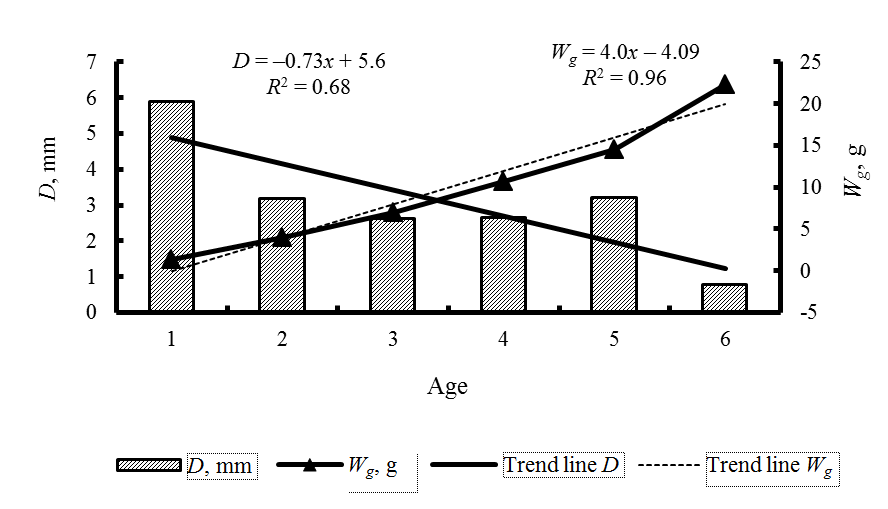
Fig. 3. Dependence of gonad mass Wg and egg diameter D on the age of females
Reproductive effort Wgen is one of the most important characteristics of the reproductive capabilities of a species and shows what part of the energy the species spends on reproduction. In the Curonian Lagoon smelt, the lowest reproductive effort was recorded in yearlings (0.16), the highest in six yearlings (0.33), and females aged two to five years were characterised by approximately the same reproductive effort, which varied from 0.28 to 0.30. The dependence of reproductive effort on the age of females was approximated by a power function, the determination factor was R2 = 0.8 (Fig. 4).

Fig. 4. Dependence of reproductive effort Wgen on the age of females
Animal fertility is in one way or another connected with the population size and, consequently, with the population dynamics. The population size is reflected by the commercial stock of the population. In the interannual aspect, the antiphase of the dynamics of the commercial stock size and the absolute individual fertility is noted (Fig. 5).

Fig. 5. Dynamics of the commercial stock (CS) population and absolute individual fecundity (AIF) of smelt
In years with high abundance of commercial stock, absolute individual fertility has low values and vice versa.
Results and discussion
The study of the fertility of different fish species has a long history. It has been shown that absolute and relative individual fertility, while being in an allometric dependence on the length and weight of body, has an exponent close to one. This allows one to describe the dependence by a linear function. To describe the dependence of AIP and RIF on the body weight of the smelt of the Curonian Lagoon, a power function, which is more consistent with the biological meaning, was used since in the absence of an individual, its fertility is zero, while with a linear display, fertility has
a numerical value [3].
In the Curonian Lagoon, smelt generally matures at the age of 2-3 years. Only in some years were mature adults recorded at the age of 1 year. The structure of the spawning population of smelt in the Curonian Lagoon is similar to the structure of smelt populations from water bodies in north western Russia [8]. Absolute individual fertility in smelt in northwest Russia also regularly increased with age. The relative individual fertility of smelts demonstrated comparative stability, which is typical of short-cycle fish [5]. In long-cycle fish, a decrease in relative individual fertility is recorded. It should be noted that the average weight of smelts in the Curonian Lagoon was comparable to that in other lakes, including Lake Ladoga. But the absolute and relative individual fertility of Curonian smelts was on average 2-3 times higher [8].
A number of authors note that the violation of the relationship between the AIF and body weight in older age groups indicates unfavourable living conditions of the population, primarily food availability [9]. Fluctuations in the determination factor of this relationship can be used as an adequate population reproduction stability indicator [4]. In the Curonian Lagoon, this relationship demonstrated a stable relationship with a determination factor of 0.8 and an exponent close to one.
The diameter of the eggs is of great importance for the stability of recruitment. The size of the eggs determines the yolk content and, first of all, the amount of fat and other nutrients. The diameter of the eggs naturally decreases with the age of the females; it is minimal even in the youngest individuals [2]. This dependence was also recorded in the smelt of the Curonian Lagoon, but the females of high-yielding generations, which mature at the age of 1 year, had the maximum diameter of the eggs. As a rule, individuals, that mature at an earlier age, can be characterised by
a shorter lifespan and the quantity of spawn. However, at an earlier age they can produce more viable offspring [10]. Usually, this phenomenon is characteristic of unfavorable living conditions for the species. It can be assumed that a high number of recruits creates tense trophic intraspecific relationships and early maturation served as compensation for the impact of increased mortality due to low food supply.
Reproductive effort or gonadosomatic index is one of the most important indicators of the reproductive capabilities of the species. Ultimately, it reflects what part of the energy contained in the body weight is spent on reproduction [3]. Smelts of the Curonian Lagoon spend more energy on generative growth than many other fish species, the reproductive effort of which varies from 0.05 to 0.27; and only in European eels it reaches 0.47 [3]. The low gonadosomatic index in yearlings can be determined by the redistribution of female energy towards somatic growth.
For the smelt of the Curonian Lagoon, it has been shown on long-term material that absolute individual fertility and commercial stock change in the opposite direction. In periods with low commercial stock, absolute individual fertility increases, and in years with high commercial stock, it decreases. This phenomenon may indicate the self-regulation of the population.
Conclusion
European smelts Osmerus eperlanus of the Curonian Lagoon, like all short-cycle fish species, can be characterised by significant fluctuations in catch. In commercial catches, smelts are represented by individuals from one to six years old, which corresponds to the commercial catch structure in the water bodies of northwest Russia. The absolute individual fertility of smelts of the Curonian Lagoon is several times higher than in the water bodies of northwest Russia, which is probably due to favourable trophic conditions for fattening in the Baltic Sea. Smelts of the Curonian Lagoon spend more energy on generative growth than smelts of other water bodies and fish of other species. The reproductive effort trend data (gonadosomatic index) demonstrate relative stability, which indicates the population reproduction sustainability. All of the above allows us to conclude that fish fertility data can be used as a key indicator of the reproductive strategy and fish population dynamics.
1. Aleksandrov S. V. Pervichnaia produktsiia planktona v lagunakh Baltiiskogo moria (Vislinskii i Kurshskii zalivy) [Primary plankton production in the lagoons of the Baltic Sea (Vistula and Curonian Gulfs)]. Kaliningrad, Izd-vo AtlantNIRO, 2010. 227 p.
2. Nikol'skii G. V. Teoriia dinamiki stada ryb [Theory of fish herd dynamics]. Moscow, Pishchevaia promyshlennost' Publ., 1974. 448 p.
3. Alimov A. F., Bogutskaia N. G. Zakonomernosti sviazi plodovitosti s massoi tela i skorost'iu rosta u ryb [Patterns of correlation of fertility with body weight and growth rate in fish]. Zhurnal obshchei biologii, 2003, vol. 64, no. 2, pp. 112-127.
4. Shatunovskii M. I., Ruban G. I. Ecological Aspects of Age Related Dynamics of Fish Reproductive Parameters. Russian Journal of Ecology, 2009, vol. 40, no. 5, pp. 320-327.
5. Shatunovskii M. I., Ruban G. I. Vnutrividovaia iz-menchivost' zhiznennykh strategii boreal'nykh ryb na pri-mere vidov s shirokim arealom [Intraspecific variability of life strategies of boreal fish on the example of species with a wide range]. Izvestiia RAN. Seriia biologicheskaia, 2010, no. 4, pp. 486-497.
6. Pravdin I. F. Rukovodstvo po izucheniiu ryb (pre-imushchestvenno presnovodnykh) [Guidelines for the study of fish (mainly freshwater)]. Moscow, Pishchevaia promyshlennost' Publ., 1966. 259 p.
7. Malkin K. M., Borisov V. M. Metodicheskie rek-omendatsii po kontroliu rybnykh zapasov i otsenke chislennosti ryb na osnove biostatisticheskikh dannykh [Methodological recommendations for the control of fish stocks and the assessment of fish abundance based on biostatistical data]. Moscow, Izd-vo VNIRO, 1987. 21 p.
8. Sterligova O. P., Il'mast N. V. Sostoianie populiatsii koriushki Osmerus eperlanus Vygozera i Siamozera, sformirovavshikhsia v rezul'tate samorasseleniia [The state of smelt populations Osmerus eperlanus Vygozer and Syamozera, formed as a result of self-dispersal]. Voprosy ikhtiologii, 2012, vol. 52, no. 3, pp. 358-364.
9. Shatunovskii M. I., Ruban G. I. O nekotorykh novykh podkhodakh k izucheniiu vosproizvodstva ryb [Some new approaches to the study of fish reproduction]. Aktual'nye problemy sovremennoi ikhtiologii (k 100-letiiu G. V. Nikol'skogo): sbornik statei. Moscow, Tovarishchestvo nauchnykh izdanii KMK Publ., 2010. Pp. 241-261.
10. Moiseenko T. I. Vodnaia ekotoksikologiia: teoreticheskie i prikladnye aspekty [Aquatic ecotoxicology: theoretical and applied aspects]. Moscow, Nauka Publ., 2009. 399 p.